There are 34 quotes matching Charles Lindbergh in the collection:
My father had been opposed to my flying from the first and had never flown himself. However, he had agreed to go up with me at the first opportunity, and one afternoon he climbed into the cockpit and we flew over the Redwood Falls together. From that day on I never heard a word against my flying and he never missed a chance to ride in the plane.
Charles Lindbergh
We, 1928.
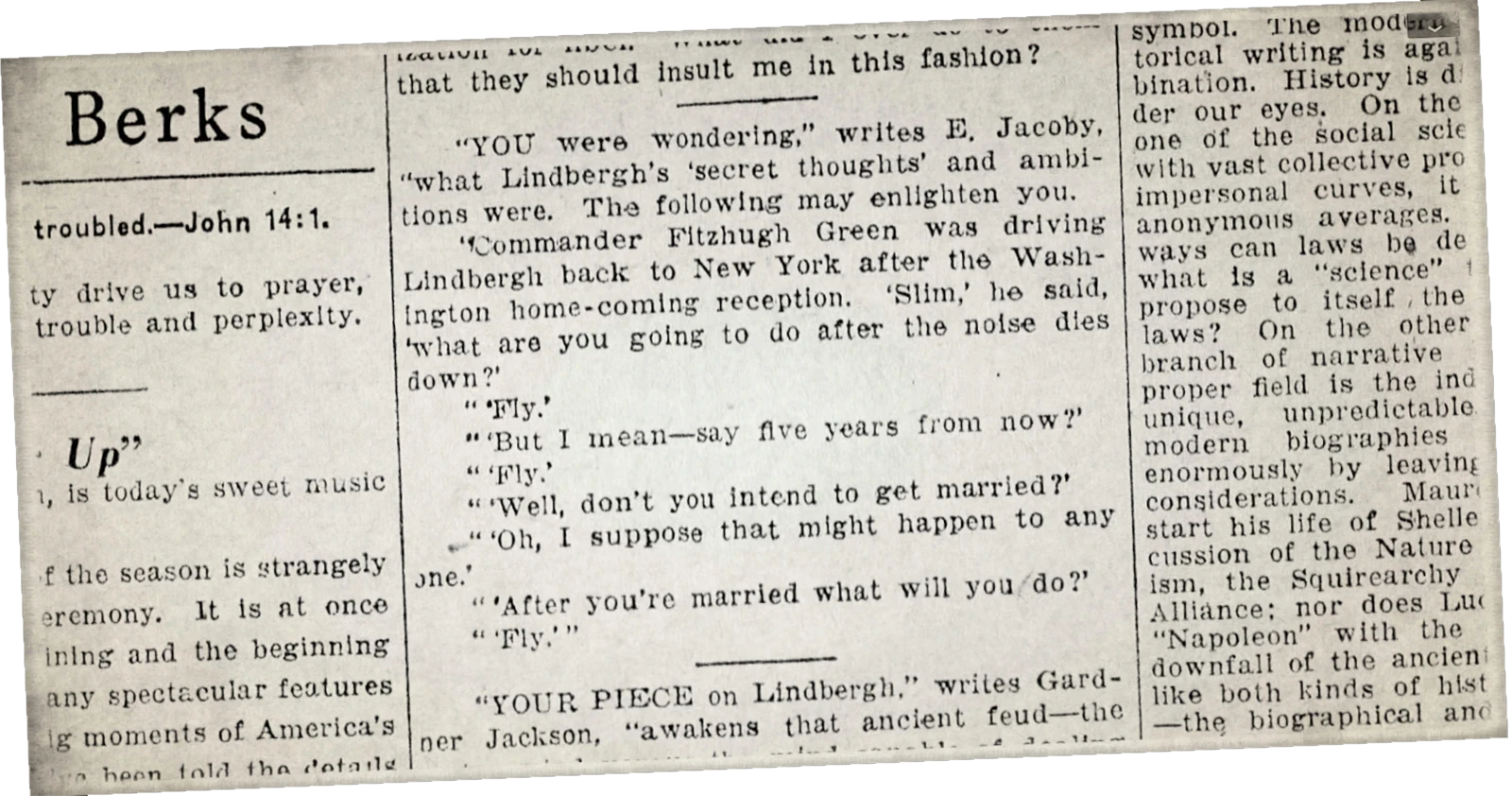
Commander Fitzhugh Green was driving Lindbergh back to New York after the Washington home-coming reception. 'Slim,' he said, 'what are you going to do after the noise dies down?'
'Fly.'
'But I mean—say five years from now?'
'Fly.'
'Well, don't you intend to get married?'
'Oh, I suppose that might happen to anyone.'
'After you're married what will you do?'
'Fly.'
Charles Lindbergh and his chief secretarial aide Fitzhugh Green
Story in several 1928 publications, including The New York World newspaper and U.S. Air Services magazine. This copy from the Reading Times newspaper, Reading, Pennsylvania, 18 April 1928. While probably planted by Green, it rings true to Lindy's concise speaking style and his deep love of flying.
These phantoms speak with human voices — friendly, vapor-like shapes, without substance, able to vanish or appear at will, to pass in and out through the walls of the fuselage as though no walls were there … familiar voices, conversing and advising on my flight, discussing problems of my navigation, reassuring me, giving me messages of importance unattainable in ordinary life.
Charles Lindbergh
Writing about his first solo flight across the Atlantic. The Spirit of St. Louis, 1953.
Lying under an acacia tree with the sound of the dawn around me, I realized more clearly the facts that man should never overlook: that the construction of an airplane, for instance, is simple when compared [with] a bird; that airplanes depend on an advanced civilization, and that where civilization is most advanced, few birds exist. I realized that If I had to choose, I would rather have birds than airplanes.
Charles Lindbergh
During a trip to Africa. Is Civilization Progress?, in Reader’s Digest, July 1964. Quoted in his New York Times obituary, 27 August 1974.
Why does one want to walk wings? Why force one’s body from a plane to make a parachute jump? Why should man want to fly at all? People often ask these questions. But what civilization was not founded on adventure, and how long could one exist without it? Some answer the attainment of knowledge. Some say wealth, or power, is sufficient cause. I believe the risks I take are justified the sheer love of the life I lead.
Charles Lindbergh
The Spirit of St. Louis, 1953.
After reading … accounts … of minor accidents of light, it is little wonder that the average man would far rather watch someone else fly and read of the narrow escapes from death when some pilot has had a forced landing or a blowout, than to ride himself. Even in the postwar days of now obsolete equipment, nearly all of the serious accidents were caused by inexperienced pilots who where then allowed to fly or attempt to fly — without license or restrictions about anything they could coax into the air …
Charles Lindbergh
We, 1928.
Planes may even replace automobiles someday, just as automobiles replaced horses. Possibly everyone will travel by air in another fifty years. I’m not sure I like the idea of millions of planes flying around overhead. I love the sky's unbroken solitude. I don’t like to think of it cluttered up by aircraft, as roads are cluttered up by cars. I feel like the western pioneer when he saw barbed-wire fence lines encroaching on his open plains. The success of his venture brought the end of the life he loved.
Charles Lindbergh
The Spirit of St. Louis, 1953.
I may be flying a complicated airplane, rushing through space, but in this cabin I’m surrounded by simplicity and thoughts set free of time. How detached the intimate things around me seem from the great world down below. How strange is this combination of proximity and separation. That ground — seconds away — thousands of miles away. This air, stirring mildly around me. That air, rushing by with the speed of a tornado, an inch beyond. These minute details in my cockpit. The grandeur of the world outside. The nearness of death. The longness of life.
Charles Lindbergh
The Spirit of St. Louis, 1953.
By day, or on a cloudless night, a pilot may drink the wine of the gods, but it has an earthly taste; he's a god of the earth, like one of the Grecian deities who lives on worldly mountains and descended for intercourse with men. But at night, over a stratus layer, all sense of the planet may disappear. You know that down below, beneath that heavenly blanket is the earth, factual and hard. But it's an intellectual knowledge; it's a knowledge tucked away in the mind; not a feeling that penetrates the body. And if at times you renounce experience and mind's heavy logic, it seems that the world has rushed along on its orbit, leaving you alone flying above a forgotten cloud bank, somewhere in the solitude of interstellar space.
Charles Lindbergh
The Spirit of St. Louis, 1953.
It is about a period in aviation which is now gone, but which was probably more interesting than any the future will bring. As time passes, the perfection of machinery tends to insulate man from contact with the elements in which he lives. The 'stratosphere' planes of the future will cross the ocean without any sense of the water below. Like a train tunneling through a mountain, they will be aloof from both the problems and the beauty of the earth's surface. Only the vibration from the engines will impress the senses of the traveller with his movement through the air. Wind and heat and Moonlight take-offs will be of no concern to the transatlantic passenger. His only contact with these elements will lie in accounts such as this.
Charles Lindbergh
Foreword to his wife’s 1938 book Listen! The Wind.

Science, freedom, beauty, adventure: what more could you ask of life? Aviation combined all the elements I loved. There was science in each curve of an airfoil, in each angle between strut and wire, in the gap of a spark plug or the color of the exhaust flame. There was freedom in the unlimited horizon, on the open fields where one landed. A pilot was surrounded by beauty of earth and sky. He brushed treetops with the birds, leapt valleys and rivers, explored the cloud canyons he had gazed at as a child. Adventure lay in each puff of wind.
I began to feel that I lived on a higher plane than the skeptics of the ground; one that was richer because of its very association with the element of danger they dreaded, because it was freer of the earth to which they were bound. In flying, I tasted a wine of the gods of which they could know nothing. Who valued life more highly, the aviators who spent it on the art they loved, or these misers who doled it out like pennies through their antlike days? I decided that if I could fly for ten years before I was killed in a crash, it would be a worthwhile trade for an ordinary life time.
Charles Lindbergh
The Spirit of St. Louis, 1953.
The readiness to blame a dead pilot for an accident is nauseating, but it has been the tendency ever since I can remember. What pilot has not been in positions where he was in danger and where perfect judgment would have advised against going? But when a man is caught in such a position he is judged only by his error and seldom given credit for the times he has extricated himself from worse situations. Worst of all, blame is heaped upon him by other pilots, all of whom have been in parallel situations themselves, but without being caught in them.
If one took no chances, one would not fly at all. Safety lies in the judgment of the chances one takes. That judgment, in turn, must rest upon one’s outlook on life. Any coward can sit in his home and criticize a pilot for flying into a mountain in fog. But I would rather, by far, die on a mountainside than in bed. Why should we look for his errors when a brave man dies? Unless we can learn from his experience, there is no need to look for weakness. Rather, we should admire the courage and spirit in his life. What kind of man would live where there is no daring? And is life so dear that we should blame men for dying in adventure? Is there a better way to die?
Charles Lindbergh
Journal entry, 26 August 1938. Later published in The Wartime Journals, 1970.
I watched him strap on his harness and helmet, climb into the cockpit and, minutes later, a black dot falls off the wing two thousand feet above our field. At almost the same instant, a while streak behind him flowered out into the delicate wavering muslin of a parachute — a few gossamer yards grasping onto air and suspending below them, with invisible threads, a human life, and man who by stitches, cloth, and cord, had made himself a god of the sky for those immortal moments.
A day or two later, when I decided that I too must pass through the experience of a parachute jump, life rose to a higher level, to a sort of exhilarated calmness. The thought of crawling out onto the struts and wires hundreds of feet above the earth, and then giving up even that tenuous hold of safety and of substance, left me a feeling of anticipation mixed with dread, of confidence restrained by caution, of courage salted through with fear. How tightly should one hold onto life? How loosely give it rein? What gain was there for such a risk? I would have to pay in money for hurling my body into space. There would be no crowd to watch and applaud my landing. Nor was there any scientific objective to be gained. No, there was deeper reason for wanting to jump, a desire I could not explain.
It was that quality that led me into aviation in the first place — it was a love of the air and sky and flying, the lure of adventure, the appreciation of beauty. It lay beyond the descriptive words of man — where immortality is touched through danger, where life meets death on equal plane; where man is more than man, and existence both supreme and valueless at the same instant.
Charles Lindbergh
Contemplating his first parachute jump, The Spirit of St. Louis, 1953.
He did it alone. We had a cast of a million.
Attributed to Neil Armstrong
Regards Charles Lindbergh.
See 14 other Neil Armstrong great aviation quotes.
Didn’t find what you were looking for? Start again at the home page, or try another search: