I have social feeds on Facebook, X, and BlueSky, plus Instagram, for updates and conversation.
Newest quote to the collection:
The delta wing is not a shape. It is a philosophy of flight.
Alexander Lippisch
German aerodynamicist, who conceived and built the Delta I between 1930 and 1931, a tailless, delta-planform glider that validated the aerodynamic principles he had been developing since the mid-1920s. Quote from Lippisch Delta I – The First Step Towards the Delta Wing Revolution, www.onlineaviationlibrary.com.
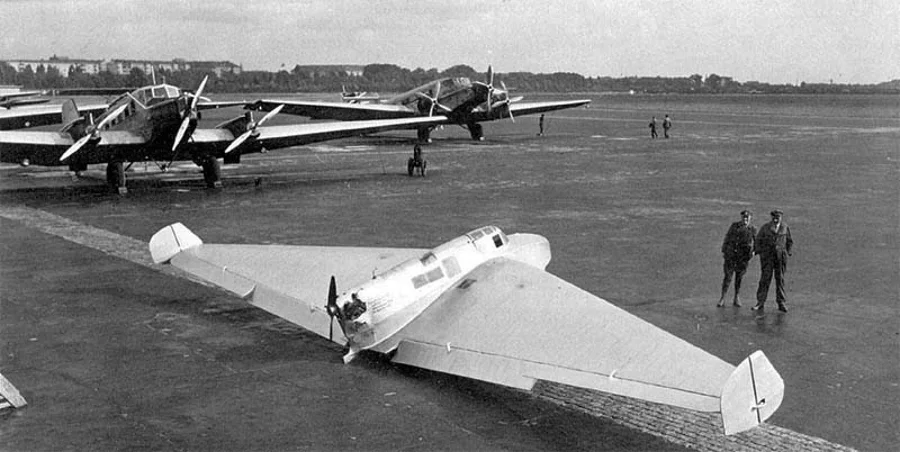
On this day, 89 years ago:
Why, about 300 years ago, when a man was studying aviation and trying to make a flying machine—he was a priest—he abandoned those studies because, he said, “if ever this succeeds there is no city in any country which would not be an object of horrible assaults.” What was regarded with horror in the Middle Ages, and certainly in the last 300 years, is now accepted as an arid commonplace by all politicians and philosophers of civilised Europe at the present time. We have certainly discovered this great secret of the air at a time when the human race has shown that its virtues do not unfit it to receive such a great gift.
Winston Churchill
At the time Member of Parliament for Epping, speech in the House of Commons, 27 July 1937.
See more Winston Churchill aviation quotes.
The most misquoted avquote?
When once you have tasted flight, you will forever walk the Earth with your eyes turned skyward, for there you have been, and there you will always long to return.
Wrongly attributed to Leonardo da Vinci.
This may be one of the most famous aviation quotes — but it wasn’t Leonardo! It’s attributed everywhere to him (including some Smithsonian publications, the Washington Post newspaper, a 2024 National Geographic movie, aviation magazines, and a couple of science quotation books), but he never said or wrote it. It’s fakey fake fake. For the full story on who did, see my August 2020 article in Air Facts magazine The Famous Quote That Da Vinci Never Said.
Although … after that article was published, I unearthed these da Vinci drawings in the archives of the Universitas Ingeniorum Artis Artificialis in Florance, Italy. Are these the proof he tasted flight?

The Leonardo ‘tasted flight’ quotation now fuels my desire to discover the original source and correctly cite all the quotes. Like this one, penned by the real da Vinci, on flying and writing, birds and men:
Feathers shall raise men even as they do birds, towards heaven; that is by letters written with their quills.
Leonardo da Vinci
The Notebooks of Leonardo Da Vinci: Arranged, Rendered into English and Introduced by Edward MacCurdy, 1938.
The object here is to capture man’s first-hand experiences with flight in all its forms, to collect and document our spoken and written words about aviation. It’s the ultimate online quotable flyer. It is not ‘under construction’, but it very much is a ‘work in progress’. If you can supply dates or sources for existing quotes, or correct my typos, or suggest further sources of quotations, or if you spot some cool new quotes, please send them in.
I started the site in 1996, using Netscape Navigator 3.0 Gold and hand-coded HTML in Windows Notepad. Internet Archive has screenshots from 1997. It was featured in the LA Times (17 December 1996) and USA Today (17 April 1997) newspapers. Now the quotes are organized in a SQL database, on a website built using Dreamweaver.
Back then research meant college libraries and dusty card indexes. Now with wholesale scanning and digitalization of old books and magazines, finding the exact original source of a quotation is finally possible. Plus, an airline pilot’s salary buys a lot of used books. Tons of corrections made over the decades to the sometimes third-hand quotes I first found reading flying books in the late 80’s.
The initial collection was published by McGraw-Hill, and became a bestseller back when books were sold in the Discovery Channel stores in malls. The back cover had this kind blurb from the wonderful pilot and educator Rod Machado, “… succinct, power-packed bits of wisdom which are easily digested by the reader. There’s much to be learned as well as enjoyed.” It was translated into Japanese and, by popular demand, a second volume was also published.
The collection has been cited in several academic papers, used as a resource for many books and movies, and was even liked by Chuck Yeager. Now spreading wings on Pinterest and Instagram.
It’s pretty neat that I’ve been able to share so many sky treasures, many from a ‘special section on private bookshelves’:
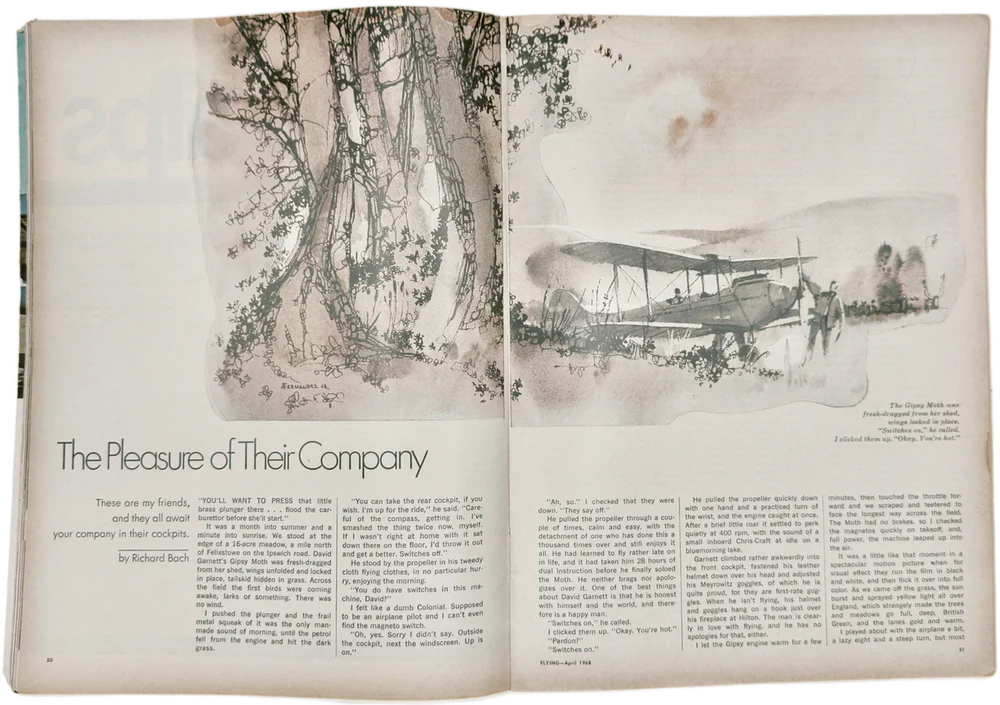
Thousands of volumes have been written about aviation, but we do not automatically have thousands of true and special friends in their authors. That rare writer who comes alive on a page does it by giving of himself, by writing of meanings, and not just of fact or of things that have happened to him. The writers of flight who have done this are usually found together in a special section on private bookshelves.
Richard Bach
The Pleasure of Their Company, Flying magazine, April 1968.
See more Richard Bach aviation quotes.
Airmanship is remarkable in that respect. There is something about it that shows almost immediately in the way a man behaves with airplanes; even in the way he merely talks about them at dinner. It shows in magazine articles; you often feel you can guess the exact number of hours the author has had, if any.
Wolfgang Langewiesche
I’ll Take the High Road, 1939.
See more Wolfgang Langewiesche aviation quotes.
Or like a poet woo the Moon,
Riding an armchair for my steed,
And with a flashing pen harpoon
Terrific metaphors of speed.
Roy Campbell
The Festivals of Flight, 1930.
I wish I could write well enough to write about aircraft. Falkner did it very well in Pylon but you cannot do something some one else has done though you might have done it if they hadn’t.
Ernest Hemingway
Letter to Harvey Breit, 3 July 1956.
See more Ernest Hemingway aviation quotes.
The planes, the weather, the foreign fields, the crashes, and most of all that special pilot's world, the earth as seen from above, and the pleasure of being up there. It isn't often that a writer of superlative skills knows enough about flying to write well about it; Saint-Exupery was one; Salter is another.
Samuel Hynes
A Teller of Tales Tells His Own, in The New York Times, 7 September 1997.


