What? Only sixteen hours! Are you sure?
Orville Wright
On hearing about the first nonstop flight across the Atlantic by Allcock and Brown, evening of 15 June 1919. Quoted in 1968 book Famous First Flights That Changed History.
I hope you find what you are looking for. And maybe discover something you had no idea about!
There are 25 quotes matching Orville Wright in the collection:
What? Only sixteen hours! Are you sure?
Orville Wright
On hearing about the first nonstop flight across the Atlantic by Allcock and Brown, evening of 15 June 1919. Quoted in 1968 book Famous First Flights That Changed History.
Sport first of all. After that, its use in exploration and in war. And after war … Oh well, you can guess as well as we can.
Wright Brothers
Quoted in The Sport of Flying, The Outing Magazine, May 1909.
The course of the flight up and down was exceedingly erratic, partly due to the irregularity of the air, and partly to lack of experience in handling this machine.
Orville Wright
Writing in the Flying and the Aero Club of America Bulletin, December 1913.
We realized the difficulties of flying in so high a wind, but estimated that the added dangers in flight would be partly compensated for by the slower speed in landing.
Orville Wright
How We Made The First Flight, Flying magazine, December 1918.

I cannot but believe that we stand at the beginning of a new era, the Age of Flight, and that the beginnings of to-day will be mightily overshadowed by the complete successes of to-morrow.
Orville Wright.
Country Life in America magazine, January 1909.
I’ve seen him! I’ve seen him! Yes, I have today seen Wilbur Wright and his great white bird, the beautiful mechanical bird. There is no doubt! Wilbur and Orville Wright have well and truly flown.
Le Figaro
11 August 1908.
See three other Le Figaro great aviation quotes.
Success four flights thursday morning all against twenty one mile wind started from Level with engine power alone average speed through air thirty one miles longest 57 seconds inform Press home Christmas.
Orville Wright
17 December 1903. This first telegraph home had two transcription errors. It should have read 59 seconds and Orville’s name was spelled Orevelle. Bishop Milton Wright received the telegram at about 5:30 PM, and showed it to Katharine a few minutes later. Supper was delayed while the telegram was sent over to Lorin’s home and the news was telegraphed to Octave Chanute.

The wildest stretch of the imagination of that time would not have permitted us to believe that within a space of fifteen years actually thousands of these machines would be in the air engaged in deadly combat.
Orville Wright
From radio message on 16 December 1923, broadcast on Station WLW, Cincinnati for 20th anniversary of the first flight. Quoted in 2004 book The Published Writings of Wilbur and Orville Wright .
Learning the secret of flight from a bird was a good deal like learning the secret of magic from a magician. After you once know the trick and what to look for you see things that you did not notice when you did not know exactly what to look for.
Orville Wright
Letter to Horace Lytle, 27 December 1941.

I feel about the airplane much as I do in regard to fire. That is, I regret all the terrible damage caused by fire. But I think it is good for the human race that someone discovered how to start fires, and that it is possible to put fire to thousands of important uses.
Orville Wright
Asked during WWII if he ever regretted being involved in the invention of the airplane.
The way to fly is to go straight up … Such a machine [the helicopter] will never compete with the airplane, though it will have specialized uses, and in these it will surpass the airplane. The fact that you can land at your front door is the reason you can’t carry heavy loads efficiently.
Orville Wright
During the Sikorsky XR-4’s arrival/demonstration at Wright Field in 1942. Quoted in the wonderfuly titled 1944 book Anything a horse can do: the story of the helicopter. Often wrongly attributed to Emile Berliner.
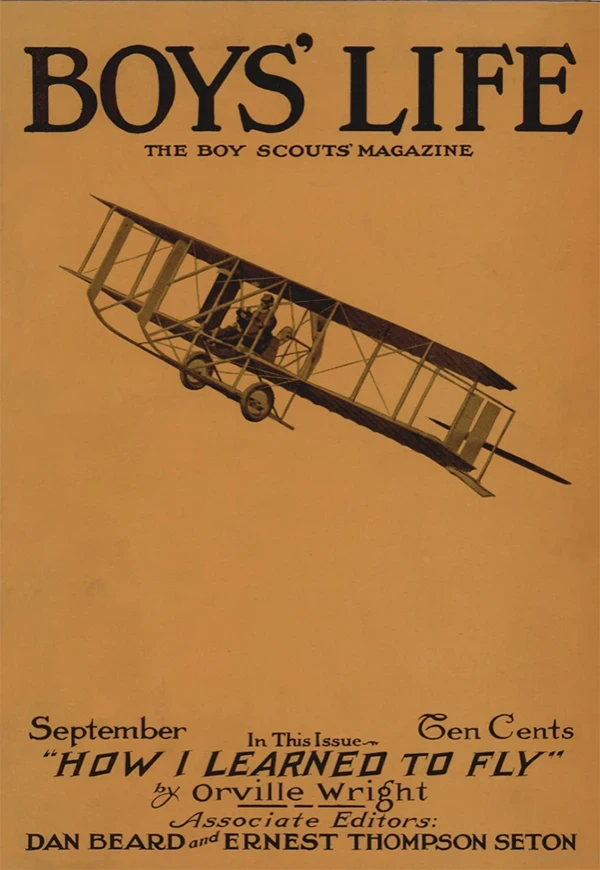
My brother climbed into the machine. The motor was started. With a short dash down the runway, the machine lifted into the air and was flying. It was only a flight of twelve seconds, and it was uncertain, wavy, creeping sort of flight at best; but it was a real flight at last and not a glide.
Orville Wright
Describing the first flight of a heavier-than-air aircraft. How I Learned to Fly, as told to Lesie W. Quirk, Boys’ Life magazine, September 1914.
When my brother and I built and flew the first man-carrying flying machine, we thought that we were introducing into the world an invention which would make further wars practically impossible. That we were not alone in this thought is evidenced by the fact that the French Peace Society presented us with medals on account of our invention.
Orville Wright
Letter to C. M. Hitchcock, 21 June 1917.
I found myself caught in them wires and the machine blowing across the beach heading for the ocean, landing first on one end and then on the other, rolling over and over, and me getting more tangled up in it all the time. I tell you, I was plumb scared. When the thing did stop for half a second I nearly broke up every wire and upright getting out of it.
John T. Daniels
He snapped the famous photo of the Wright's first flight, here describing what happened to the Wright Flyer later that day. Quoted in 2004 book The Published Writings of Wilbur and Orville Wright
All who are practically concerned with aerial navigation agree that the safety of the operator is more important to successful experimentation than any other point. The history of past investigations demonstrates that greater prudence is needed rather than greater skill. Only a madman would propose taking greater risks than the great constructors of earlier times.
Wilbur Wright
July 1901. First published as Die wagerechte Lage Während des Gleitfluges in Illustrierte Aeronautische Mitteilungen. Wilbur’s original unpublished English manuscript did not survive. This translation from The Papers of Wilbur and Orville Wright.
See 22 other Wilbur Wright great aviation quotes.
It is a bare possibility that a one-man machine, without a float and favored by a wind of, say, fifteen miles an hour, might succeed in getting across the Atlantic, but such an attempt would be the height of folly. When one comes to increase the size of the craft the possibility rapidly fades away. This is because of the difficulties of carrying sufficient fuel… It will readily be seen, therefore, why the Atlantic flight is out of the question.
Orville Wright
Quoted in Aircraft, May 1914.
The original Wright brothers aeroplane the world’s first power-driven, heavier-than-air machine in which man made free, controlled, and sustained flight invented and built by Wilbur and Orville Wright flown by them at Kitty Hawk, North Carolina December 17, 1903. By original scientific research the Wright brothers discovered the principles of human flight as inventors, builders, and flyers they further developed the aeroplane, taught man to fly, and opened the era of aviation.
Inscription next to The Flyer
When it was finally brought back to the United States and unveiled at the Smithsonian in 1948, after that institution dropped claims that Langley was first with powered flight.

Like all novices we began with the helicopter in childhood, but soon saw that the helicopter had no future, and dropped it. The helicopter does with great labor only what the balloon does without labor, and is no more fitted than the balloon for rapid horizontal flight. If its engine stops, it must fall with deathly violence, for it can neither glide like the aeroplane or float like the balloon. The helicopter is much easier to design than the aeroplane, but is worthless when done.
Wilbur Wright
Letter written in 1907. Quoted in the 1954 book Miracle at Kitty Hawk: The Letters of Wilbur and Orville Wright.
See 22 other Wilbur Wright great aviation quotes.
The flying machine which will really fly might be evolved by the combined and continuous efforts of mathematicians and mechanicians in from one million to ten million years — provided, of course, we can meanwhile eliminate such little drawbacks and embarrassments as the existing relation between weight and strength in inorganic materials. No doubt the problem has attractions for those it interests, but to the ordinary man it would seem as if effort might be employed more profitably.
New York Times
Flying Machines Which Do Not Fly, by an anonymous author (presumably an editor) in The New York Times, 9 October 1903. I have a good PDF copy.
The exact date they predicted inorganic flight might take a million years is unfortunate for the Times, as it was on 9 October 1903 one Orville Wright wrote in his diary: “We started assembly today.”
As of 1992, in fact—though the picture would have improved since then—the money that had been made since the dawn of aviation by all of this country's airline companies was zero. Absolutely zero.
Sizing all this up, I like to think that if I’d been at Kitty Hawk in 1903 when Orville Wright took off, I would have been farsighted enough, and public-spirited enough—I owed this to future capitalists—to shoot him down. I mean, Karl Marx couldn't have done as much damage to capitalists as Orville did.
Warren Buffett
Billionaire investor, interview in Fortune magazine, 22 November 1999.
See one other Warren Buffett great aviation quote.
Didn’t find what you were looking for? Start again at the home page, or try another search: